
Poor communication in the workplace is far more than an annoyance. It's a quiet threat to your company’s stability and growth, leading to operational failures that dismantle projects, hurt morale, and create significant financial and legal risks. Addressing these communication gaps isn't a "soft skill" initiative—it's a core business imperative for any leader focused on building a resilient organization.
When instructions are vague, feedback is inconsistent, and information is siloed, the entire organization suffers. Many leaders underestimate the tangible costs, viewing poor communication as a minor issue teams should resolve on their own. This perspective overlooks the severe, compounding consequences that impact efficiency, culture, and your bottom line.

The financial toll of these breakdowns is staggering. A remarkable 86% of employees and executives identify poor communication as a primary cause of workplace failures. For U.S. companies, this translates to an estimated $1.2 trillion lost annually. This isn't just a hypothetical problem; it shows up in real, measurable ways that hurt your business. You can find more of these eye-opening stats in this workplace communication breakdown from Chanty.com.
These financial leaks appear in several key areas:
Leaders often believe they have communicated clearly, while their teams are left confused or working with conflicting information. This disconnect between intent and reception is where significant costs accumulate.
Beyond the direct financial impact, poor communication damages your company’s operational integrity and culture. When employees lack clear direction or feel unheard, a toxic environment can develop. Mistrust grows, morale declines, and information vacuums are filled with rumors, distracting everyone from their goals.
This creates a painful ripple effect. Your most talented employees, frustrated by the lack of clarity, may start looking for other opportunities. For a growing business, losing key personnel disrupts continuity and hinders your ability to scale effectively.
Ultimately, addressing poor communication is a strategic necessity. By building systems that promote clarity and transparency, you protect your financial health and create a culture where your teams can succeed. If these challenges sound familiar, it may be time to assess your organization's communication framework. Strengthening these foundations is the first step toward building a more resilient business.
Effective communication is the engine of a healthy business. When that engine sputters, it rarely happens all at once. Poor communication often reveals itself through subtle symptoms that, if ignored, can escalate into major operational threats. Learning to spot these early red flags allows you to address small issues before they become company-wide crises.

Think of these signs as practical diagnostics that help you check your organization’s health. By recognizing them, you can shift from reacting to problems to preventing them, protecting your morale, productivity, and bottom line. The table below outlines the most common indicators that communication is beginning to fail.
These signs are more than minor annoyances; they are symptoms of deeper issues. Let’s explore what each of these looks like in practice.
One of the first and most obvious signs of poor communication is a spike in rework. Your teams may consistently miss the mark on deliverables, not due to a lack of skill, but because of a lack of clarity. This occurs when instructions are vague, critical details are omitted, or employees make assumptions instead of asking for confirmation.
This is the corporate version of the "game of telephone." A manager shares instructions that become distorted as they pass from person to person. The result is wasted hours, frustrated employees, and delayed projects—all stemming from an initial message that wasn't clear.
Have you ever discovered that two different departments were unknowingly working on the same problem? This is a classic symptom of information silos. When teams do not share information, they operate in a vacuum, which leads directly to duplicated work and wasted resources.
For example, your marketing team might be developing a customer feedback survey while the product team creates a similar one. Both teams have good intentions, but without a central way to communicate their activities, they squander valuable time and energy. This disconnect hurts efficiency and can lead to confusing messages for your customers.
When official communication channels are inadequate, unofficial ones will always fill the void. An increase in rumors is a clear sign that employees are not receiving the information they need from leadership. This "grapevine effect" is a natural response to an information vacuum, but the details it carries are often incorrect, incomplete, or negative.
This can create a toxic culture built on speculation instead of facts. Employees may hear whispers about potential layoffs long before an official announcement, causing unnecessary anxiety and eroding trust. Left unchecked, these informal discussions can escalate into more serious employee disputes and conflict resolution challenges.
Another subtle but telling sign is a decline in employee engagement. Team members who once shared ideas in meetings may become quiet. This withdrawal is often a response to the frustration of feeling unheard or consistently misunderstood.
When employees feel their input doesn't matter, they may stop trying. They start doing only what is explicitly asked of them, and you lose their innovation and proactive contributions. This passive behavior is a quiet but serious red flag pointing to a deep communication failure.
Identifying the warning signs of poor communication is just the first step. To create lasting change, you must dig deeper and address the root causes. Most communication failures are not isolated mistakes but symptoms of broken systems and ingrained habits that make misunderstanding almost inevitable.
When leaders fail to address these foundational issues, they often find themselves managing the same problems repeatedly. The good news is that once you identify these root causes, you can build solutions that truly last.
One of the most common sources of workplace chaos is the lack of clear guidelines for communication. When your team has to guess whether a question belongs in an email, a chat channel, or a project board, critical information is bound to get lost. This creates a constant state of low-level anxiety where people spend more time searching for information than acting on it.
This lack of structure often leads to predictable problems:
You can eliminate this guesswork by establishing simple protocols. For instance, define email for formal announcements, a chat tool for quick questions, and a project management system as the single source of truth for tasks. When everyone knows where to find information, work flows more smoothly.
Clarity must start at the top. When messages from leadership are vague, contradictory, or infrequent, they create a ripple effect of confusion throughout the organization. A leader may believe they have delivered a clear vision, but if the team leaves with multiple interpretations of what to do next, the communication has failed.
This often happens when leaders communicate from their own perspective, forgetting what their audience needs to hear to perform their jobs effectively. Ambiguous messaging is especially damaging during times of change. If there isn't a clear, consistent narrative from leadership, employees will fill the silence with rumors and anxiety, leading to disengagement and distrust.
Nothing stifles open communication faster than fear. In workplaces where asking questions, admitting confusion, or respectfully challenging an idea is discouraged, employees learn to stay silent. They will pretend to understand rather than risk appearing incompetent by seeking clarity.
This silence is incredibly costly. It leads to preventable mistakes, missed opportunities, and derailed projects—all because someone was afraid to ask a simple question. Building psychological safety, where your team feels secure enough to speak up without fear of punishment, is the foundation of transparent communication. It enables a business to learn, adapt, and grow.
Understanding these systemic issues is key to moving beyond temporary fixes. When you’re ready to build a stronger communication framework, expert guidance can help. To discuss your organization's specific challenges, please get in touch with our team.
Poor communication in the workplace is more than an operational headache—it is a significant source of legal and compliance risk. For any business, especially those in regulated industries or operating across multiple states, the stakes are high. Ambiguous performance reviews, inconsistently applied policies, and poorly documented disciplinary actions can dismantle a company’s legal defense in an employment dispute.
When communication is unclear, it can create perceptions of bias and unfair treatment. An offhand comment from a manager can be easily misinterpreted. A verbal warning that is never documented might as well have never happened from a legal standpoint. These seemingly minor lapses expose your business to claims of discrimination, retaliation, and wrongful termination.
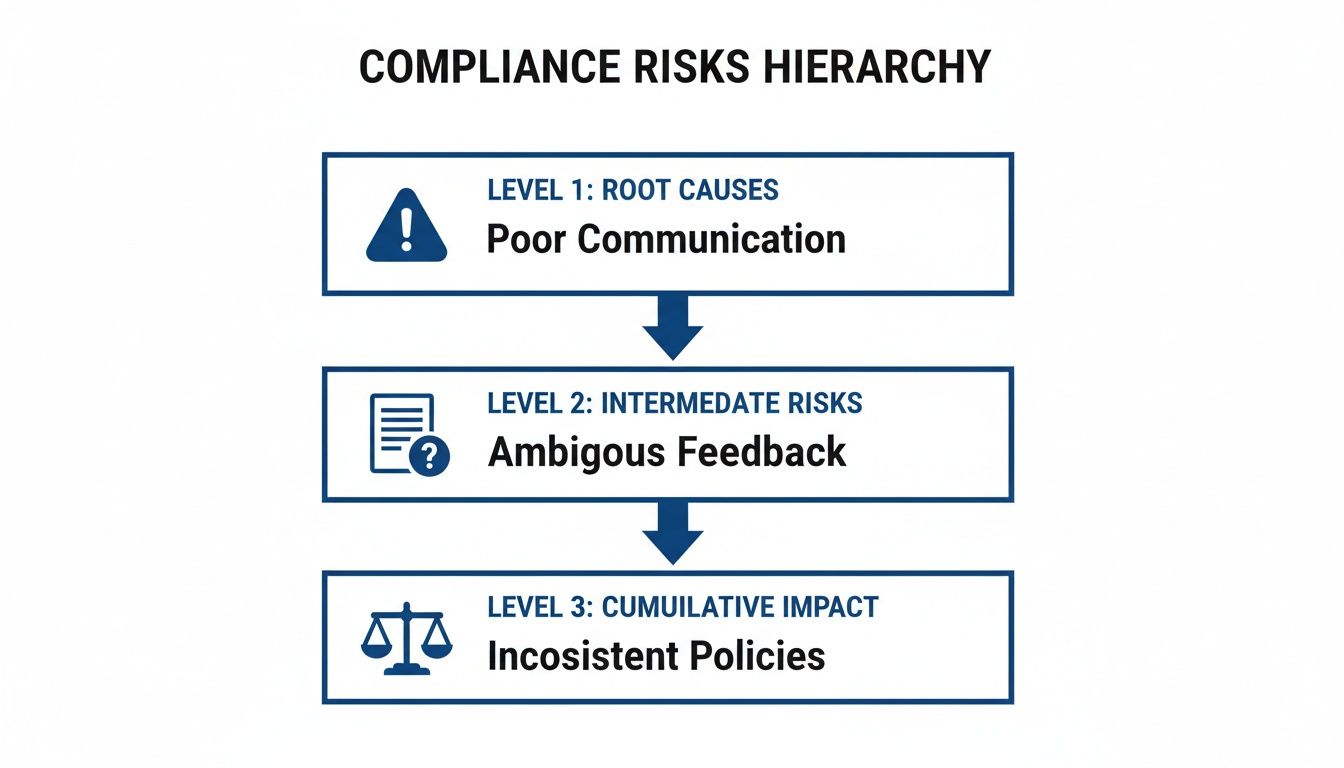
One of the most common ways poor communication creates risk is through performance management. Consider a manager who avoids difficult conversations with an underperforming employee. Instead of documenting specific performance gaps, they offer vague, positive feedback like, "You're doing a great job!" to be encouraging.
Months later, when the business terminates the employee for poor performance, the employee is blindsided. If they file a wrongful termination lawsuit, their attorney will request the performance reviews. When a company's official documentation shows a history of positive feedback, it directly contradicts the reason for termination, undermining the employer's credibility. The manager’s desire to avoid an uncomfortable conversation has created a significant legal liability.
Another major compliance risk arises when company policies are applied inconsistently. When rules are enforced for some employees but not others, it opens the door to discrimination claims. For example, if one employee receives a formal write-up for tardiness while another who is frequently late faces no consequences, the disciplined employee may argue they are being unfairly targeted.
This inconsistency often results from poor communication from leadership. If managers are not trained on how to apply policies uniformly, or if the policies themselves are poorly written, each manager may enforce them differently.
These communication failures can lead to serious legal challenges:
Ensuring all managers understand and communicate policies consistently is critical. This requires clear documentation, regular training, and a centralized system for handling disciplinary actions. Building these internal systems is a key part of developing defensible HR strategies for compliance.
Let's move from identifying communication breakdowns to actively fixing them. This requires a deliberate, structured approach. Lasting improvement comes from building solid systems and clear protocols that make clarity the default, not the exception.
These strategies are more than just good ideas; they are defensible business practices that reduce ambiguity and shield your organization from preventable risks. By implementing these foundational pillars, you create a framework where effective communication can thrive.
One of the most important steps you can take is to establish clear and consistent documentation standards, especially for performance management. Vague, subjective feedback is a significant liability. To combat this, every performance review, disciplinary action, and piece of formal feedback must be based on objective, behavioral terms.
For example, instead of a manager writing, "John has a bad attitude," the documentation should state, "On three separate occasions this month, John spoke dismissively to colleagues in team meetings, causing disruption." This simple change shifts the focus from a subjective opinion to an observable, factual behavior. These standards should be applied consistently, and all leaders must be trained to document performance conversations with this level of precision.
Having standards is one thing; ensuring your managers can execute them is another. Many managers avoid difficult conversations because they lack the confidence or skill to deliver feedback well. Investing in coaching can bridge that gap.
Manager coaching should focus on practical, real-world skills:
When managers have these tools, they are more likely to address performance issues early and consistently. For those looking to foster better dialogue, learning how to improve communication skills in the workplace is a crucial step.
In today's workplace, information moves through countless channels. Without a formal policy, this can create chaos. A communication policy is a simple roadmap that tells everyone which tool to use for which purpose, removing guesswork from the equation.
Your policy should clearly define the "rules of the road":
A simple policy like this sets clear expectations, reduces information overload, and ensures critical details don't get lost.
When an employee complaint arises, a fair, consistent, and well-documented investigation is your best defense against legal claims. A structured protocol ensures every investigation is handled with the same level of care and objectivity.
This protocol should outline every step, from who to notify and how to document interviews to the specific, neutral questions to ask. By standardizing the process, you remove the risk of individual bias and ensure every employee receives fair treatment. This not only protects the company legally but also reinforces a culture of trust.
Fixing poor communication requires more than a one-time training session. A real, lasting solution involves weaving clear communication into your company's culture. It’s a shift from reacting to problems to proactively building an environment of trust where open dialogue is the default.

This cultural change must start at the top. Senior leaders must consistently model the communication behaviors they expect from their teams. When executives are transparent, listen actively, and admit they don't have all the answers, it sets a powerful tone for the entire organization.
The cornerstone of open communication is psychological safety. This means creating an environment where employees feel comfortable speaking up, asking tough questions, or admitting a mistake without fear of punishment. When that safety exists, people are more likely to voice concerns early, preventing small issues from becoming major problems.
To build psychological safety, leaders should:
This creates the space for honest conversations that drive innovation and problem-solving. It is also a critical component for improving workplace relations for managers and their teams.
A strong communication culture requires constant adjustment. Reliable feedback loops—such as regular "ask me anything" sessions with leadership, anonymous suggestion boxes, and candid project debriefs—provide ongoing channels for a genuine two-way dialogue. These tools help your organization listen, adapt, and improve.
When feedback is consistently sought, acknowledged, and acted upon, employees see that their voice matters. They become active partners in the company's success. A product roadmap, for example, can serve as a powerful strategic communication tool to ensure everyone is aligned.
Building this culture is a long-term commitment. It is the framework that supports sustainable growth and keeps your team working together. When these challenges feel complex, seeking expert guidance can make a significant difference. If you are ready to build a more communicative organization, we can help you create the necessary framework. Contact the team at Paradigm to learn more.
Navigating workplace communication can bring up tough questions. Here are answers to some of the most common ones we hear from business owners and HR leaders.
Measuring communication effectiveness is possible by tracking business metrics directly impacted by it.
Start tracking these key indicators:
Before implementing new policies, the most critical first step is a visible commitment from leadership. Leaders must openly acknowledge the need for improvement and model the desired behaviors. This means actively listening, delivering consistent messages, and encouraging open dialogue.
Once leadership is on board, conduct a simple audit. Ask your teams where communication breaks down most often. Their feedback will provide a clear roadmap for your efforts.
Improving communication is a foundational step toward building a stronger, more resilient business. If you're ready to move from recurring issues to lasting solutions, our team can help you develop the systems and frameworks needed for clear, defensible communication. To learn more, contact us to learn how we can help.