
A manager walks into your office. The performance issues have dragged on, the team is frustrated, and the employee has already challenged a policy decision. Now the question lands on your desk: can we terminate, and if so, how do we do it without creating a bigger problem?
That moment is where termination rules stop being abstract. They become a business risk issue with legal, financial, and operational consequences. A rushed decision can trigger claims of discrimination, retaliation, inconsistent treatment, or wage-payment violations. A delayed decision can keep a weak fit in role, undercut manager credibility, and drain team performance.
The most useful way to handle termination isn't to memorize isolated rules. It's to use a decision framework that tests the reason, the documentation, the timing, the state-law requirements, and the practical logistics before anyone schedules the meeting. That approach gives leaders something far more valuable than speed. It gives them a defensible process.
In most of the United States, employment is at-will. That means an employer can generally end employment with or without cause, as long as the reason isn't illegal. That sounds simple until you apply the exceptions. Discrimination, retaliation, contract issues, public policy violations, final pay rules, and multi-state conflicts can all turn an ordinary separation into a claim.
Leaders also need to think upstream. Termination risk often starts long before the final decision, with inconsistent feedback, vague expectations, or failure to address problems early. That's one reason it helps to pair separation planning with proven methods for reducing staff turnover. Better retention practices won't eliminate the need for termination, but they often reduce the number of preventable cases and improve the quality of your documentation when separation does become necessary.
At-will employment is the default rule in most of the country. In 49 out of 50 states, employers can generally terminate employees with or without cause, as long as the reason isn't illegal. Montana is the sole exception. The practical takeaway is simple: at-will gives flexibility, but it doesn't give immunity from legal scrutiny, and the financial stakes are high. According to wrongful termination cost data summarized here, termination can cost a company up to 200% of the employee's annual salary, and an average wrongful termination lawsuit costs companies over $100,000.
A useful mental model is this: at-will answers whether a business usually needs cause. It doesn't answer whether the employer can prove the reason was lawful, consistent, and properly executed.
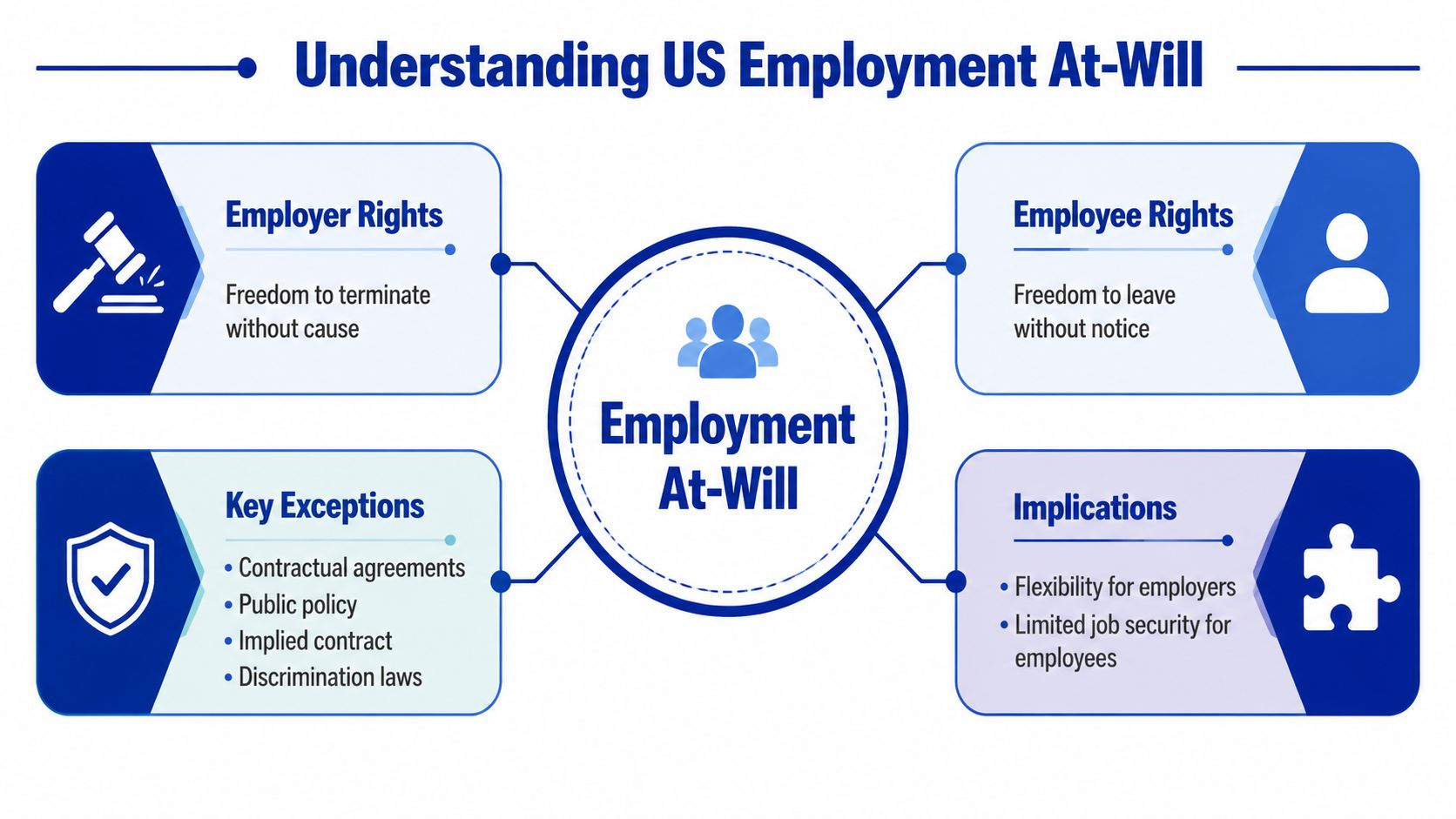
At-will usually allows two things:
That said, practical HR management should never treat "can terminate" as the only question. The right question is whether the decision will hold up if challenged months later by the employee, an agency, or opposing counsel.
Several exceptions narrow the doctrine fast:
Practical rule: Treat every termination as if someone will later ask for the file and timeline. If your answer is "we just knew it was time," the process probably isn't ready.
Leaders who want a cleaner primer on the doctrine itself can review this breakdown of the employment at-will doctrine. The key point for decision-makers is that at-will is a starting point, not a defense strategy.
Most risky terminations don't fail because the employer lacked frustration. They fail because the timing, comments, history, or documentation make the decision look tied to a protected category or protected activity.
Protected-category analysis starts with discipline in how leaders talk about the employee and the reason for separation. If the file says "missed deadlines, policy violations, attendance issues, and customer complaints," that's one thing. If managers have been saying "not energetic enough," "too old-school," "not a culture fit," or "has too many medical issues," you've created a different risk profile entirely.
Termination decisions should be screened against unlawful motives, including discrimination based on race, gender, age, disability, and national origin. That review should happen before the meeting is scheduled, not after the termination letter is drafted.
Use a short internal test:
If a manager can't pass those four tests cleanly, the termination needs more review.
Retaliation claims often arise from timing. An employee complains, reports a problem, or asserts a legal right, and then gets terminated shortly afterward. Even when the employer believes the decision is justified, a weak record can make the action look retaliatory.
Under the FLSA and OSHA protections summarized here, an employer can't terminate an employee for asserting wage-and-hour rights such as filing a claim for unpaid wages or overtime, and OSHA protects employees from retaliatory discharge for reporting safety violations.
That means these situations need immediate caution:
A lawful termination can still become an expensive claim if the sequence of events makes the business reason look like an afterthought.
Multi-state employers should be even more careful. A headquarters team may view the case through one state's assumptions, while the employee's location creates a different legal context. That's one reason a termination review should include both the employee's actual work location and any recent protected activity, not just the manager's recommendation.
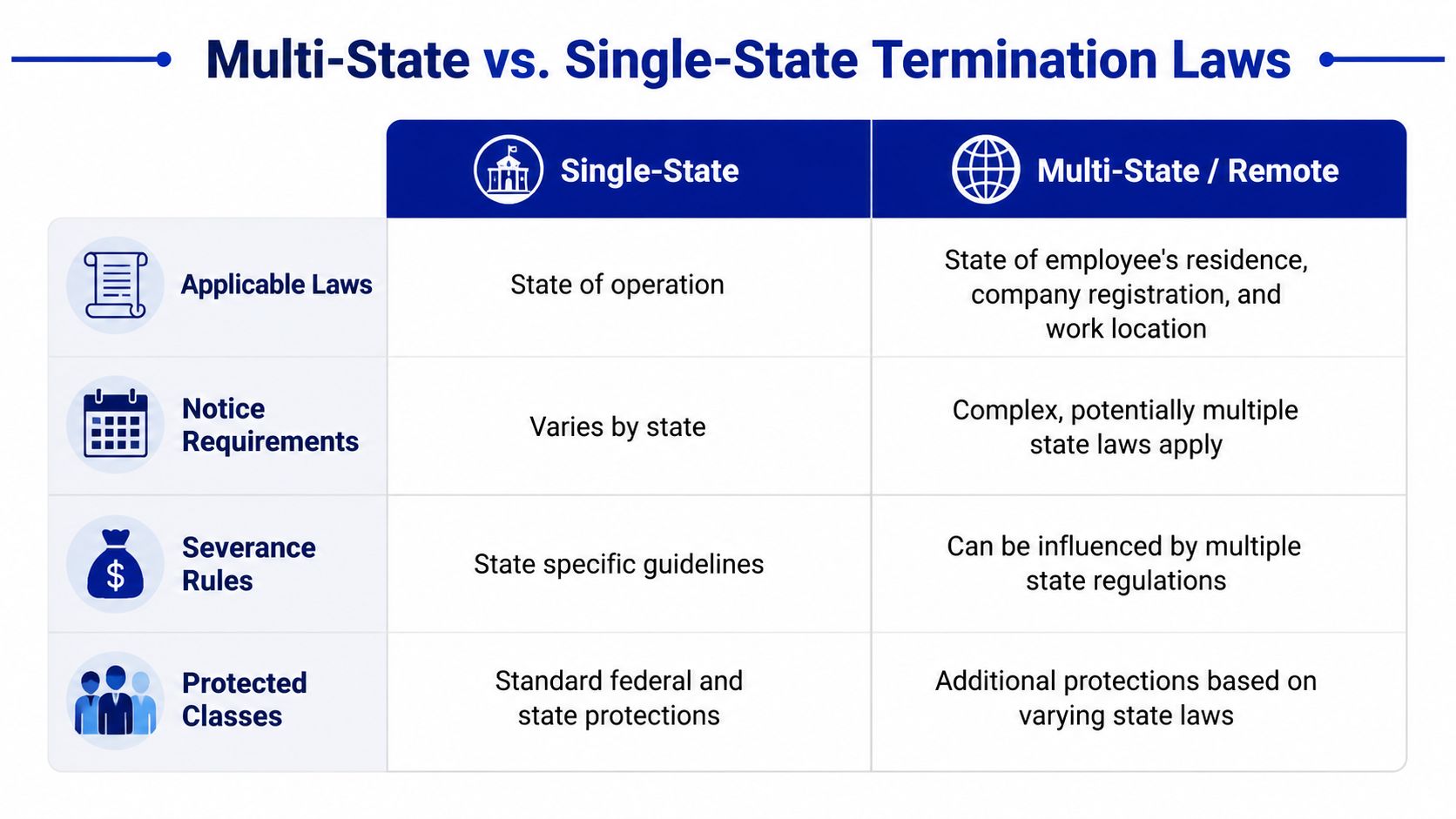
Single-state employers can usually build a stable termination process around one set of state rules. Multi-state and remote employers don't have that luxury. The same termination decision can be routine in one state and risky in another because notice, final pay, and discharge standards don't line up neatly across jurisdictions.
That difference becomes urgent when leaders assume the company's home state controls everything. In practice, the employee's work location often matters more than the headquarters address.
Some termination rules are about substance. Others are about execution. Both matter.
According to this overview of employee termination law variation, California requires final pay immediately upon termination, while New York requires payment by the next regular pay cycle. The same source also notes a critical remote-work risk: a company based in an at-will state like Texas may terminate a remote employee working in a jurisdiction with stronger protections, such as Montana, creating a serious blind spot for multi-state operators.
That means the termination decision has to answer operational questions before the meeting happens:
| Issue | Why it matters |
|---|---|
| Employee work location | It may determine which state termination rules apply |
| Final paycheck timing | Errors can create wage claims even if the separation itself was justified |
| Notice obligations | Some situations trigger state or federal notice analysis |
| Recordkeeping | Multi-state reviews need a clear file showing who checked what and when |
For teams managing remote workforces, this guide to multi-state remote worker compliance is a useful companion because the compliance failure often begins before termination, in hiring, payroll setup, or manager assumptions.
The strongest practice is a single decision protocol that adjusts by employee location. Not a loose collection of manager habits. Not verbal knowledge sitting with one payroll person.
Use a location-based review before approval:
Many businesses create avoidable risk by focusing on whether the person should be terminated and ignoring whether the organization can execute the termination lawfully in that specific jurisdiction.
Documentation isn't paperwork for its own sake. It's the record that shows the employer acted for legitimate business reasons, applied standards consistently, and gave the employee fair notice of problems. Without that record, even a justified termination can look improvised.
Courts and agencies pay close attention to what the file shows. According to this summary of termination process standards, adequate documentation of progressive discipline and specific job-related failures is the cornerstone of a defensible termination, and missing records create suspicion that the actual reason was discrimination or retaliation.

Strong documentation is factual, dated, and tied to job expectations. It doesn't read like advocacy. It reads like a business record.
Useful items include:
A common mistake is relying on labels instead of facts. "Bad attitude" is weak. "Interrupted two client calls, refused assigned workflow on a documented date, and ignored a written directive" is stronger because it can be tested and explained.
Some records create more problems than they solve.
"Write what happened, not what you felt about it."
Global employers can see a similar principle in comparative resources like mastering UK termination compliance. The legal frameworks differ, but the management lesson is the same: process discipline matters most when the decision is challenged.
The safest termination process isn't built on instinct. It's built on sequence. Leaders need an order of operations that forces the right questions before action. That doesn't slow the business down. It prevents expensive mistakes.
The framework below works because it combines legal screening, documentation review, and execution planning into one decision path.
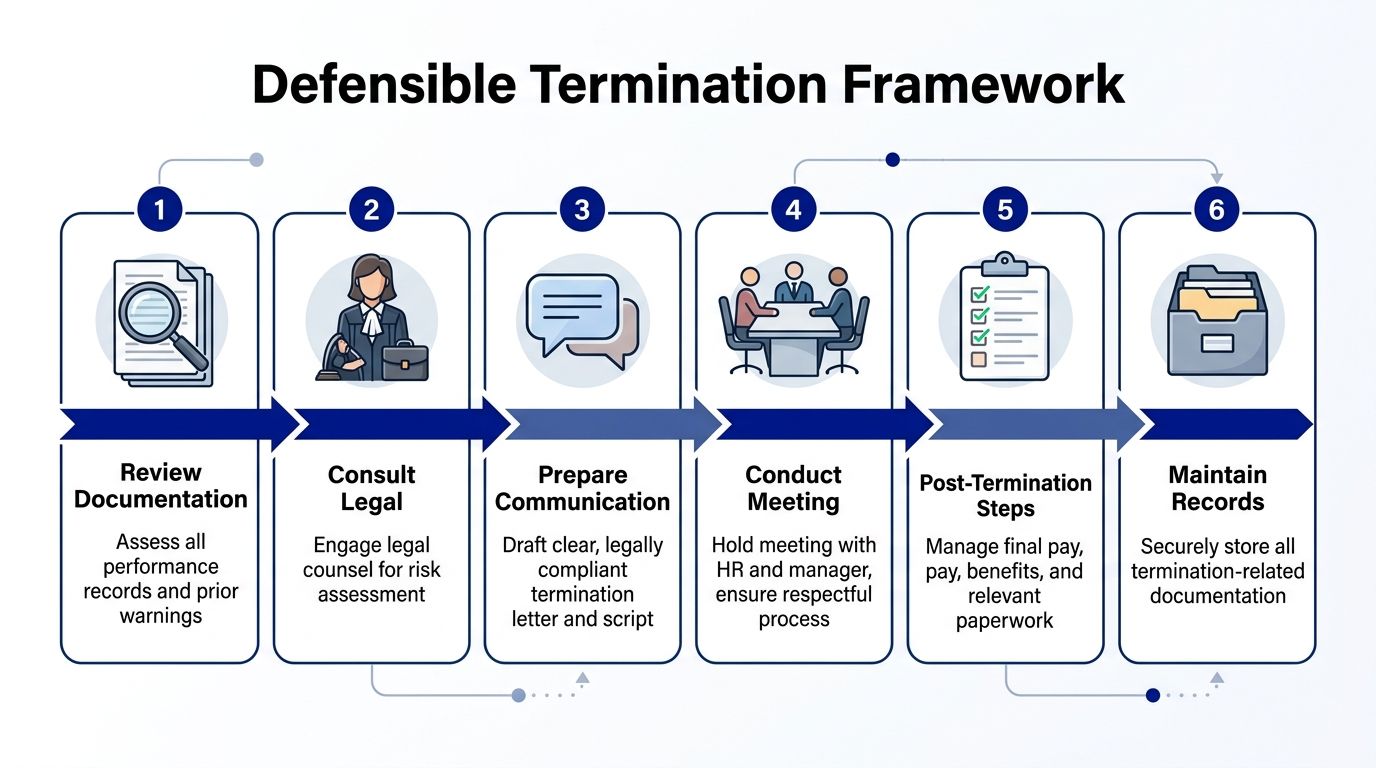
Begin by defining the business reason in one sentence. If that sentence isn't specific, the decision isn't ready.
Examples of stronger framing:
Then pressure-test the reason. Would a neutral reviewer understand it from the file alone? Would two leaders describe it the same way?
Before approval, run a focused file review. This should be structured, not conversational.
A practical tool helps here. Teams that need a repeatable internal process should use a formal termination checklist so the review isn't dependent on memory.
Even a solid decision can go sideways in execution. The meeting should be brief, respectful, and aligned with the documented reason. Don't improvise. Don't debate. Don't let the manager freelance explanations that aren't in the file.
Prepare these elements in advance:
Decision standard: If the business reason is sound but the process isn't ready, wait and fix the process first.
This is also where legal counsel becomes a strategic advantage, not a last resort. High-risk terminations often look manageable until someone reviews the timeline, the state-law issues, and the employee's recent activity in one place.
Some terminations are routine performance matters with a clean file and a low-noise history. Others carry enough legal complexity that leaders shouldn't proceed without counsel. Knowing the difference is a core part of sound judgment.
The strongest leaders don't treat legal review as hesitation. They treat it as risk control.
Legal or specialized HR review is warranted when any of these factors appear:
One specific example deserves extra attention. Under the federal WARN framework, covered employers must provide 60 days' notice before certain mass layoffs or plant closings, and failure can trigger $500 per day per worker for the first 60 days, plus back wages and benefits, as summarized in the verified data above. If a termination decision is connected to a larger workforce action, individual-case thinking is no longer enough.
The best time to involve counsel is when the decision is still adjustable. At that stage, counsel can help refine the stated reason, identify retaliation risk, review state-law execution issues, and improve the documentation trail. After the termination happens, your options narrow.
If you're facing a termination that involves mixed facts, inconsistent records, remote-work complications, or recent protected activity, it's worth getting a second set of eyes before you move. Careful review at that point often prevents the kind of preventable exposure that turns a manageable decision into a costly dispute.
If your team is facing a sensitive termination, a multi-state compliance question, or a pattern of employee relations decisions that needs tighter structure, Paradigm International Inc. can help you evaluate the risk, strengthen the process, and make the decision more defensible before action is taken.