
Have you ever discovered a new hire is earning nearly the same as your most experienced, loyal employee in a similar role? That unsettling scenario is pay compression, and it occurs when the salary gap between new hires and veteran staff shrinks to almost nothing. It is one of the most common, yet overlooked, reasons for low morale and high employee turnover. Addressing it is crucial for maintaining a healthy and productive workplace.
Pay compression has become a pressing challenge for business owners and HR leaders, particularly in a competitive hiring market. Imagine it as a salary traffic jam—new employees enter your organization at compensation levels so close to your tenured staff that it creates a bottleneck. In some cases, new hires may even earn more.
This situation does not just slow down progress; it creates significant friction within your company.

Often, pay compression happens unintentionally. To secure a talented software developer in a competitive market, you might need to make an aggressive offer. However, if that starting salary is only slightly less than what your senior developer with five years of experience earns, you have just created a pay compression problem.
When pay gaps narrow, the consequences affect the entire organization. When experienced employees learn of these disparities—which they almost always do—they may feel that their loyalty, experience, and expertise have been devalued. This is not just an emotional issue; it has a direct, measurable impact on your business.
The immediate effects are often clear:
Pay compression is a tangible business risk with serious financial and legal consequences. The tight U.S. labor market in recent years created a perfect storm for this issue, as companies offered high salaries to attract new talent, inadvertently leaving seasoned employees behind. To learn more about the market dynamics, you can review this overview of wage compression and market forces.
Pay compression is not just an issue of fairness; it is an issue of stability. A lopsided pay structure can erode institutional knowledge and expose your business to significant risks, including pay equity claims.
Ultimately, tackling pay compression is a strategic imperative. It involves protecting your investment in your people, maintaining a productive culture, and ensuring your compensation strategy is both fair and legally sound. Recognizing the problem is the first step toward building a more resilient and equitable company.
If you are concerned about pay compression and its potential impact on your business, an expert opinion can provide clarity. Schedule a consultation with our team to learn more about building a compensation strategy that works for you.
Pay compression rarely happens overnight. It is typically the result of underlying business pressures that build over time, often unnoticed until morale declines. Understanding these drivers is the first step toward building a pay structure that is both fair and defensible.
For most businesses, the problem starts not with a single decision but with a series of well-intentioned actions, such as aggressively hiring for a key role or adhering to a predictable annual raise schedule. These actions, while logical in isolation, can slowly create imbalances that devalue your most loyal and experienced team members.
One of the most common causes of pay compression is a competitive labor market. When you are competing for skilled professionals, you often need to offer higher-than-average starting salaries to attract top candidates. This can create an immediate disparity between what new hires and tenured employees earn, especially if long-term staff were hired when market rates were lower.
Consider a growing tech firm that needs a new software developer with specialized skills. To secure that candidate, the company may offer a premium salary. While this solves an immediate hiring need, the new hire's pay might be nearly identical to that of founding engineers with years of dedication, creating a classic compression scenario.
Another primary cause is the disconnect between standard internal pay raises and the rapid growth of external market rates. Many companies offer a standard 3-4% annual merit increase. However, when market salaries for key roles jump by 10% or more in a single year due to inflation or skill shortages, these small internal raises cannot keep pace.
This mismatch is a pervasive driver of pay compression. For instance, while starting salaries in some sectors rose significantly between 2021 and 2023, many merit budgets remained at around 3%. An employee hired at a competitive salary years ago may now earn less than a new hire in the same role due to these market shifts.
Without a disciplined process for updating your compensation framework, your pay structures can become obsolete quickly. Salary bands that were competitive three years ago may now be completely out of sync with current market realities, leading to inconsistent and inequitable pay decisions.
An outdated compensation structure is like navigating with an old map. You may think you are on the right path, but you could be falling further behind with every decision you make.
If you have not benchmarked your salary ranges against current market data recently, you are likely making pay decisions based on irrelevant information. Reviewing external data points, such as the legal secretary salary potential, can reveal how far internal pay scales can stray from market rates.
External regulatory changes can create compression from the bottom up. When state or local minimum wage laws increase, businesses must raise the pay for their lowest-paid workers to remain compliant. However, many businesses fail to make corresponding adjustments for supervisors or experienced employees who were already earning just above the old minimum wage.
This squeezes the pay scale, narrowing the gap between entry-level roles and the employees who manage them. These changes can also affect how you classify your team, making it critical to understand the difference between exempt vs nonexempt staff to avoid compliance issues.
Recognizing these patterns in your organization is the first step. If these issues sound familiar, it may be time to examine your compensation practices before they create lasting damage.
Pay compression may seem like an internal issue, but its consequences can impact everything from team morale to your company's bottom line. Ignoring it carries significant financial and legal weight. The costs often begin as subtle shifts in workplace culture before escalating into tangible business threats.
The damage typically starts with a quiet decline in employee morale. When experienced team members discover a new hire earns nearly the same as them, their sense of value can plummet. This affects their motivation, which can quickly lead to disengagement and a drop in productivity.
Once morale sinks, turnover often follows. Your top performers—those with deep institutional knowledge and a proven track record—are usually the first to leave. They know their worth on the open market and will not stay with an employer who does not recognize it through fair pay.
The financial impact of this turnover is significant. Replacing a single experienced employee can cost from 1.5 to 2 times their annual salary when you factor in recruitment fees, training expenses, and lost productivity. Learning how to prevent employee turnover is a critical business strategy, and addressing pay compression is a key part of that effort.
Beyond the direct costs of hiring, pay compression can damage your company culture. It can breed resentment and distrust, creating an environment where collaboration suffers. When employees feel the system is unfair, they are less likely to go the extra mile, mentor junior colleagues, or contribute to an innovative workplace.
This cultural decay has a direct impact on performance. A demotivated workforce is rarely a productive one. Projects may take longer, quality may suffer, and your company's overall efficiency can decline. What started as a compensation issue can become a pervasive drag on your ability to grow.
Perhaps the most significant risk is legal exposure. While pay compression itself is not illegal, it can lead to violations of pay equity laws. If the wage squeeze disproportionately affects employees in a protected class—based on gender, race, or age—you could face a costly discrimination lawsuit.
Unaddressed pay compression creates a legally indefensible pay structure. It undermines your ability to justify compensation decisions and leaves your business vulnerable to claims that can damage both your finances and your reputation.
The legal landscape is becoming more complex with the rise of pay transparency legislation. Recent data shows that organizations with pay compression often see higher voluntary turnover among their top performers. With pay transparency laws now active in several U.S. states and new EU directives on the horizon, companies are more exposed than ever. This makes proactive compensation management a non-negotiable part of proactive human capital risk management.
You cannot fix a problem you cannot see, and pay compression often hides within your payroll data. The good news is that you do not need to be a data scientist to find it. Uncovering compression is more about asking the right questions than running complex formulas.
The first step is a compensation audit. This is a systematic review of your current pay practices, specifically looking for inconsistencies that signal trouble. A thorough review provides an objective picture of who is paid what, helping you spot problematic patterns. For a structured approach, our HR audit checklist for SMEs can provide a useful framework.
Once your data is organized, one of the most powerful tools is the compa-ratio (comparison ratio). This simple metric shows you how an employee's salary compares to the midpoint of their designated pay range. The formula is an employee's salary divided by the salary range midpoint.
A compa-ratio of 1.0 means the employee is paid at the midpoint. A ratio below 1.0 indicates they are paid less than the midpoint, while a ratio above 1.0 means they are paid more. When you compare compa-ratios for employees in similar roles, a small gap between a new hire and a veteran can be a major red flag.
A more direct approach is to compare the salaries of new hires with those of experienced employees in the same job. This is where pay compression often becomes most obvious. You are looking for pay differences that are uncomfortably small or, in some cases, nonexistent.
As a general guideline, a pay difference of less than 15% between a new employee and a veteran in the same role may indicate a problem. When senior employees are not earning a meaningful premium for their experience and loyalty, their motivation is likely to suffer.
This infographic illustrates the escalating costs that can result from unresolved pay compression.
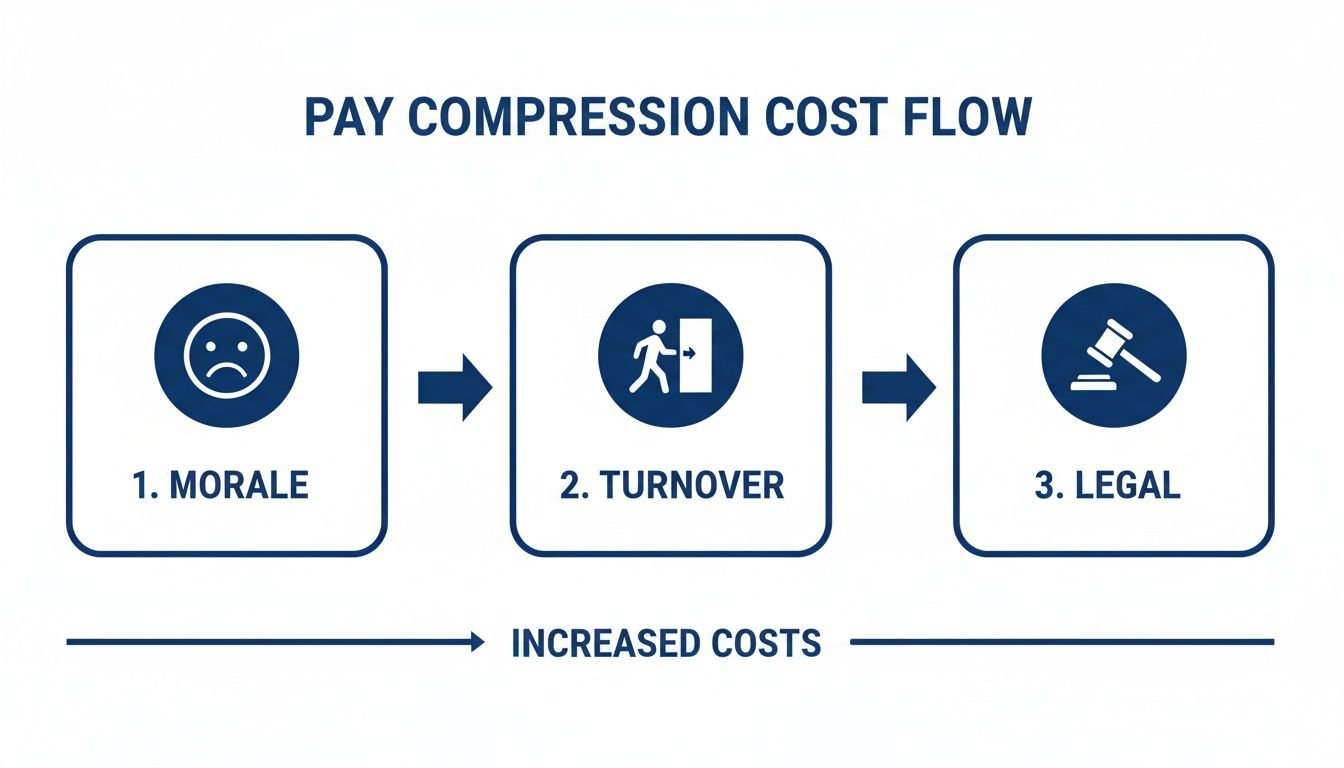
The problem often starts with morale, leads to turnover, and can ultimately result in legal issues. This shows how quickly a pay issue can become a major business threat.
To get a quick assessment of your company's pay structure, you can use your payroll data to check a few key metrics. This table breaks down what to look for and what might indicate a problem.
These metrics can serve as an early-warning system. If you see any of these red flags, it is a clear signal that you need to investigate further.
Another critical area to examine is the pay relationship between managers and their direct reports. Compression often occurs when a highly skilled new hire has a salary that is close to—or even higher than—their manager. This specific issue is called pay inversion.
A manager's compensation should always reflect their increased scope and responsibility. When a direct report earns 90% or more of their manager's salary, the incentive structure of your organization may be compromised.
This situation not only devalues the manager's role but also makes it difficult to promote top performers internally, as the associated pay increase may be minimal. Regularly auditing these manager-report pay relationships is essential for maintaining a logical and motivating career path in your company.
Discovering pay compression in your organization can be daunting, but fixing it does not have to be chaotic or overly expensive. The key is to move from analysis to action with a structured plan. This involves prioritizing adjustments based on severity, business impact, and budget.
A smart remediation plan makes deliberate, transparent moves that restore fairness for the long term.

After identifying instances of pay compression, resist the urge to fix everything at once. A prioritized approach is more manageable and effective. Sort issues based on risk to ensure your budget makes the biggest impact.
Your top priorities should be:
Instead of across-the-board raises, use targeted equity adjustments. These are one-time salary increases, separate from the regular merit cycle, designed to bring an underpaid employee’s salary in line with their peers, experience, and market value. This method is both precise and cost-effective.
When making these adjustments, document the rationale behind each one, tying it to your analysis of market data, internal equity, and performance. This creates a defensible record of your decisions.
Addressing pay compression is not an expense; it is an investment in retention and stability. A well-planned remediation strategy protects your most valuable asset—your people.
For businesses with tight budgets, a phased approach is often best. You can roll out adjustments over several quarters, starting with the highest-priority cases. This demonstrates a commitment to resolving the issue while managing cash flow responsibly.
Fixing current problems is only half the battle. To prevent pay compression from recurring, you need to update and formalize your entire compensation structure. Outdated salary bands are a common root cause of the problem.
This process involves several key steps:
A formalized structure removes guesswork from pay decisions. It gives managers a clear framework for setting salaries, awarding promotions, and giving raises, ensuring pay remains logical and equitable as your company grows. This approach transforms your compensation practices from reactive to proactive.
If you need help developing a defensible action plan that balances fairness with financial reality, our team at Paradigm can provide guidance.
Fixing existing pay gaps is a critical first step, but the long-term solution is to build a compensation strategy that prevents them from recurring. This means shifting from reactive fixes to proactive management. A thoughtful plan for prevention and communication is essential for rebuilding employee trust and ensuring your pay practices remain fair.
How you communicate these changes is just as important as the changes themselves. Handled well, this process can become a positive, culture-building moment.
Talking about pay can be sensitive, but transparency is your best tool. When employees understand the "why" behind their compensation, it can reduce suspicion and build confidence in leadership. Your communication plan should be methodical and manager-led. Equip managers with the training and talking points they need for confident, one-on-one conversations with their teams.
Key communication strategies include:
Once you have addressed immediate issues, the focus must shift to creating systems that prevent pay compression from starting. This means integrating compensation management into your regular business operations rather than treating it as an occasional emergency. A sustainable prevention strategy is built on discipline and regular reviews.
Proactive compensation management is not a project; it is a core business function. By scheduling regular reviews and adhering to a clear philosophy, you protect your company from the risks that pay compression creates.
To keep your pay structure healthy, build these practices into your annual planning:
Navigating the complexities of pay issues and communication can be challenging. If you need a partner to help you build a lasting and fair compensation framework, we are here to help.
When organizations begin to address pay compression, several common questions arise. Here are straightforward answers to the most frequent inquiries from business owners and HR leaders.
To prevent pay compression from undermining your compensation structure, proactive analysis is essential. We recommend conducting a thorough analysis at least once a year. If your business operates in a highly competitive talent market or is experiencing rapid growth, performing this analysis twice a year is a prudent strategy. This schedule helps you identify and resolve issues before they negatively impact morale.
While no specific law makes "pay compression" illegal, it can create significant legal risks. The danger arises when compression leads to pay disparities that negatively affect employees in a legally protected class (based on gender, race, age, etc.). In such cases, you could be at risk of violating equal pay laws. Maintaining fair, consistent, and well-documented pay practices is your best defense.
For most businesses, correcting every pay compression issue at once is not financially feasible. A phased approach is the most responsible way forward. You do not have to solve everything overnight.
Start by prioritizing the most urgent problems. Focus on high-risk areas first, such as top performers who might leave or managers earning less than their direct reports.
From there, you can develop a multi-year roadmap to close the remaining gaps over time. It is helpful to reframe these adjustments not as an expense, but as a critical investment in retaining the talent that drives your company's success.
Navigating compensation complexities is a high-stakes responsibility. At Paradigm International Inc., we act as a decision partner for leadership teams, helping you build defensible HR practices that support responsible growth.
If you need guidance on creating a fair and compliant compensation strategy, you can explore how we can help protect your business. Schedule a consultation with our team to learn more.